Most NZ landscapers don't find out a job went over budget until it's over. By the time you're looking at the final invoice and comparing it to what you quoted, the decisions are already made. The extra hours are already worked. The margin is already gone.
Tracking job costs as you go — not after the fact — is how you catch problems while you can still do something about them.
Why landscaping jobs run over budget
It's rarely one big blowout. It's usually a lot of small things that add up:
- Labour hours running 20% over estimate on a few tasks
- Materials that cost more than priced, or more material used than planned
- Plant hire that ran for an extra day because the job took longer than expected
- Variations that were done on a handshake and never invoiced
- A subbie who came in over quote and the difference got absorbed
None of these are dramatic on their own. Together, on a $25,000 landscaping job, they can quietly eat $3,000–5,000 of margin before you've noticed.
What cost tracking actually means
Cost tracking — or backcosting — means comparing what you estimated you'd spend against what you've actually spent, in real time, as the job progresses.
In practice, that means:
- Crew logging their hours against the specific job and task (not just clocking in and out)
- Materials recorded against the job as they're ordered or used
- Plant hire and equipment costs logged as they happen
- Subbie costs entered as invoices come in
When all of that is tracked against the original estimate, you can see — at any point in the job — whether you're on track or heading for a blowout.
Labour is where most landscaping jobs go over
Labour is the hardest cost to control because it's invisible unless you're tracking it. If your crew is logging hours to a general job code rather than to specific tasks, you can't see which parts of the job are running over until you total everything up at the end.
When timesheets are logged against tasks — excavation, planting, drainage, cleanup — you get a clear picture of where time is going. If planting is taking twice as long as estimated, you can look at why: is it a skill level issue, a site access issue, or a quoting issue? And you can act on it while the job is still live.
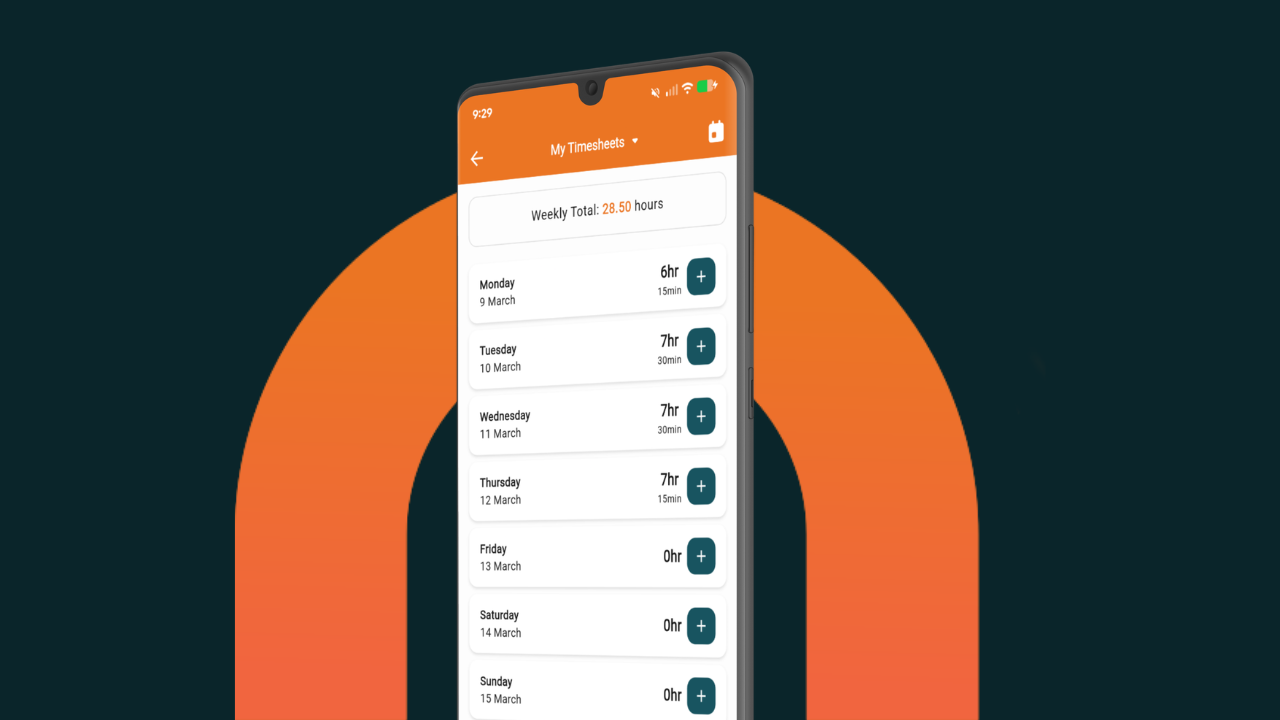
NextMinute timesheets let crew log time against specific jobs and tasks from their phone. The data flows through to your cost reports in real time — no manual entry, no end-of-week reconciliation.
Track plant hire and equipment properly
Diggers, bobcats, compactors, trucks — these costs are significant on most landscaping jobs and easy to undertrack. A common problem is that plant hire gets recorded as a general expense rather than being attached to a specific job, which means it doesn't show up in your job cost report.
Set up your machinery with buy/sell rates in NextMinute and have your crew log the hours of use on site. Your actual machinery costs flow into the job report automatically, so you can see whether you're recovering those costs through your quoting or not.
Don't let variations disappear
Variations are one of the biggest hidden costs in landscaping. The client asks for extra plants along the fence line. You say yes on site. Nobody writes it down. The extra hours get logged to the main job budget. At invoice time you either don't bill it, or you try to add it and the client disputes it because they don't remember agreeing.
Every variation — no matter how small — needs to be:
- Priced before the work starts
- Approved by the client in writing
- Tracked as its own line item, separate from the main job budget
- Invoiced on the next progress claim
When variations are tracked separately, your main job cost report stays clean and you can see exactly what was added and what it cost. NextMinute's variation and invoicing tools make this straightforward — raise the variation from site, get client approval, log costs against it, and roll it onto the next invoice.
Check your actuals vs estimates regularly
Don't wait until the job is finished to look at the numbers. Check your actuals vs estimates weekly — or at key milestones for bigger jobs. If labour is tracking 30% over estimate after the first week, that's a conversation to have now, not after six more weeks of the same.
With real-time backcosting reports in NextMinute, you can see at a glance how each job is tracking against the original quote — by labour, materials, plant hire, and total cost. It takes less than five minutes to check and it tells you everything you need to know.
Use your cost data to quote better next time
The other benefit of tracking job costs properly is that your historical data makes your future quotes more accurate. If drainage installs consistently cost 25% more in labour than you quote, that's a quoting adjustment — not bad luck. If plant sourcing is always coming in over because of transport costs you're not including, you know to add that line item next time.
Good cost tracking makes good quoting. Your quotes get sharper, your margins get more predictable, and you stop absorbing losses that should never have happened.
Start tracking your landscaping job costs today
NextMinute is built for NZ landscapers who want to know where their money is going before it's gone. Real-time cost tracking, crew timesheets, and backcosting reports — all connected to your quoting and invoicing. Book a 15-minute intro with the team →